- 1/1
“Skaller” (a shoe type) made of reindeer skin. Owner: Berlevåg Harbour Museum. Image from digitaltmuseum.org - Lisens: CC by-sa
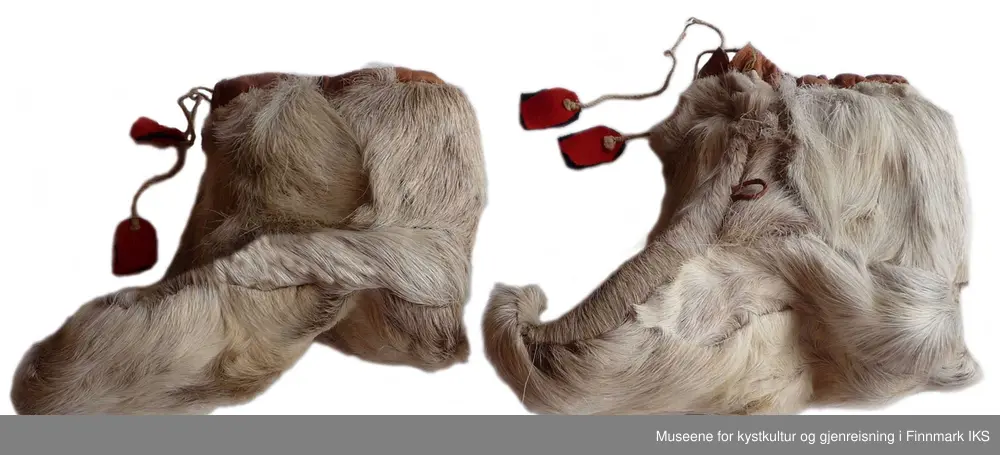
The Museum has some wonderful Sámi clothes, footwear, and other objects. Here we have a pair of “skaller” from the early 20th century, gifted to us.
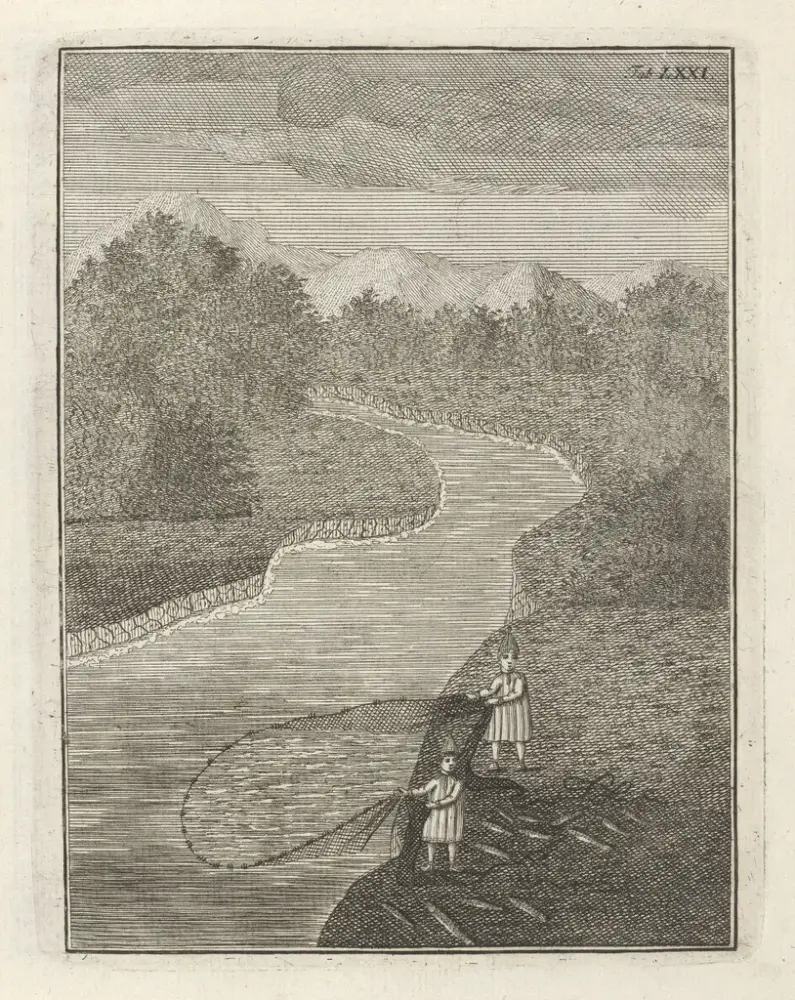
Illustration of salmon fishing with nets, 1767. Owner: The National Museum of Norway, Oslo, CC-BY.
The Older Sámi History of the Area
Berlevåg Municipality has an interesting Coastal Sámi history that spans centuries.
Archaeological finds indicate the presence of the Sámi in the area. On the Veines peninsula, for instance, we find hellegroper (stone-lined pits) from the Sámi Iron Age (c. 0–1050 CE). These stone-lined pits were used to process fish and seal. These goods were important in trade between the Sámi and the Norse chieftains further south in Norway, where seal fat was used to maintain boats and ropes. The Veines stone-lined pits are clear indicators of a Sámi trapping and trade economy that lasted until the end of the Viking Age (c. 800–1050 CE).
There are so-called many-roomed houses in the municipality, such as the Kongshavn find (near the Kjølnes Lighthouse). Finds in these many-roomed houses show trade links between the Sámi, Norwegians, and Karelians.
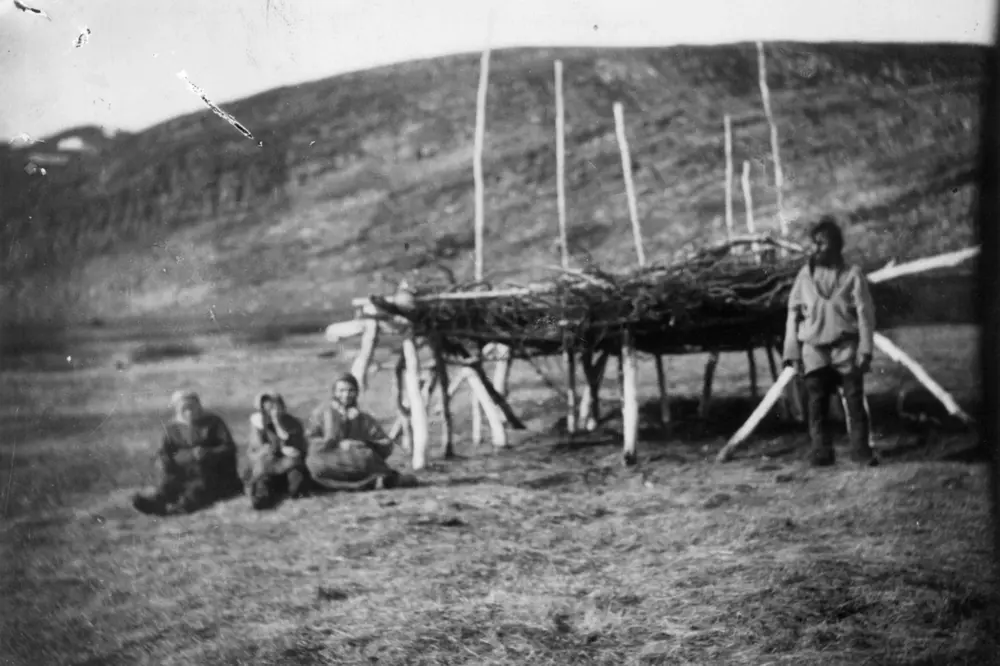
Probably a “louvvi”, which is a Sámi term for a constructed place for storage. Four people sitting outside the louvvi. Photographed in the Troll Fjord and Gulgo Fjord area, unknown date. Photographer: Konrad Nielsen. Owner: Norwegian Folk Museum. Image from digitaltmuseum.org - Lisens: CC0 - Public domain
Modern Sámi History
Some images of the Coastal Sámi population in Berlevåg survive from the 20th century. Interestingly, most of these images are not housed in the Berlevåg Harbour Museum collection, but in the Norwegian Folk Museum’s collection.
This is because the Finnmark area has been an object of scholarly interest for centuries. Take Knud Leem (1697–1774), who was educated as a clergyman at Copenhagen University. Leem travelled to Finnmark, where he knew the Sámi language and studied their culture closely. His studies resulted in the book Beskrivelse over Finmarkens Lapper, deres Tungemaal, Levemaade og forrige Afgudsdyrkelse [Description over Finnmark’s Lapps, their Tongue, Way of Life and former Idolatry] in 1767. The book spoke of language, clothing, food, tools, building techniques, reindeer herding, fishing and trapping, rituals and games. The book was also illustrated with 101 full-page illustrations, which was quite expensive in the 18th century.
Leem never visited Berlevåg, but other scholars visited in the early 20th century. Konrad Nielsen (1875–1953), professor of Finnish-Ugric languages at the University of Oslo, photographed people in Berlevåg Municipality. In the image, we are probably seeing a “louvvi”, which was a platform built for storage.
Group of people outside a house, Kongsfjord, Berlevåg. Some of them in Sámi clothing. Part of a series from a research trip to Eastern Finnmark in 1909. Photographer: Hanna Resvoll-Holmsen. Owner: Norwegian Folk Museum. Image from digitaltmuseum.org - Lisens: CC0 - Public domain
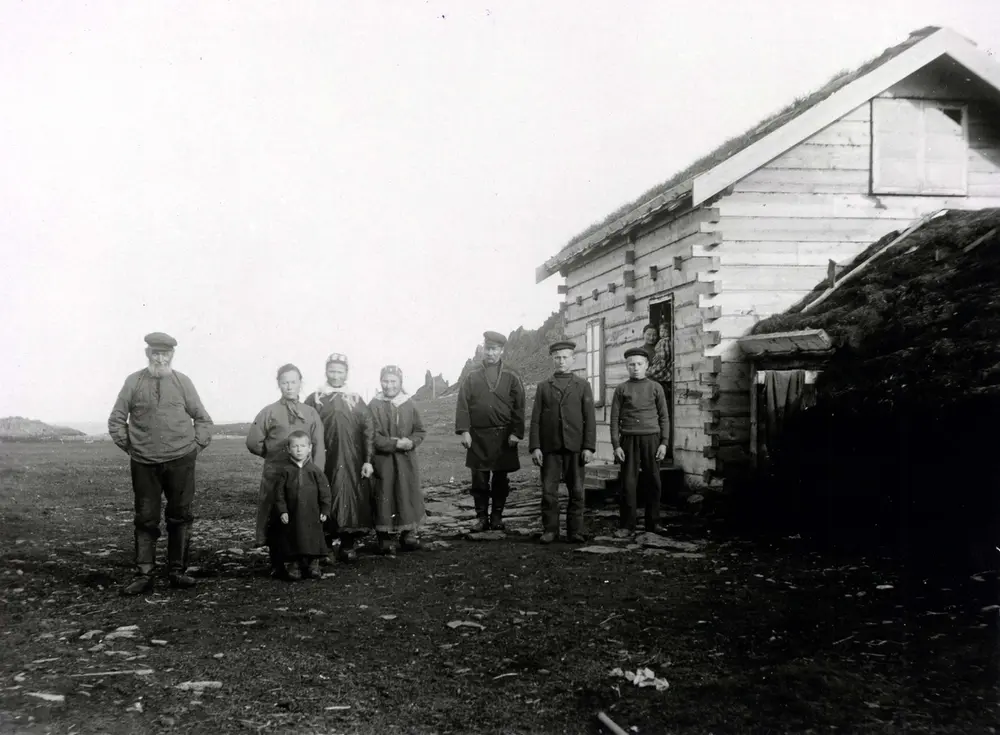
Hanna Resvoll-Holmsen (1873–1943) was a botanist, and in connection with her research on the Arctic flora, she travelled around Finnmark in 1909. In Berlevåg Municipality, she took pictures of the inhabitants of Kongsfjord, including the Coastal Sámi People who lived there.
These glimpses from the past show the diverse and complex threads of Berlevåg Municipality’s history. We hope this short post piques further reflections on Finnmark’s long history.
And with that, we wish all who celebrate a happy celebration! Lihkku beivviin!